

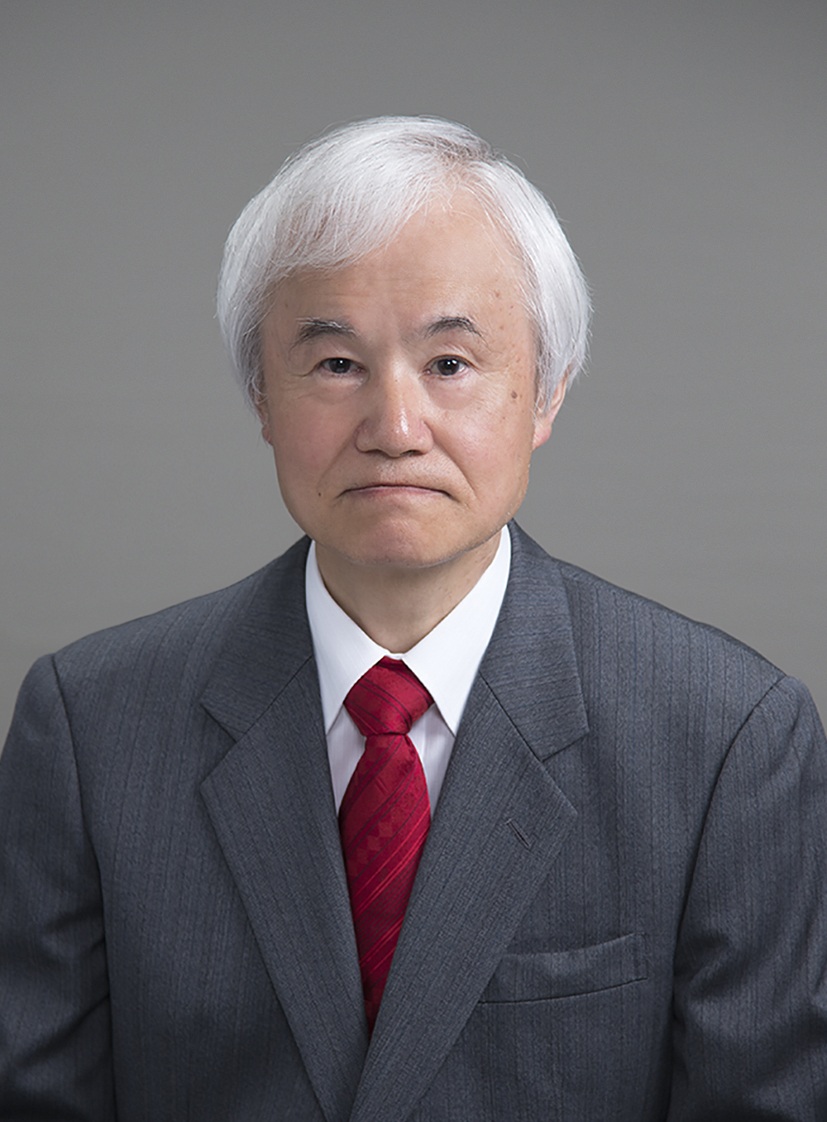
President & CEO,
Representative Director
Tadahiro Takigawa
We would like to extend our sincere gratitude for your continued support.
As the world moves toward an advanced information society, digital technology is making astounding advances. With rapidly evolving artificial intelligence, it is predicted that computer performance will eventually outperform human intelligence.
The semiconductor sector is the key to the advancement of the information society. However, over the past 30 years, Japan's semiconductor industry has lost its competitive edge, lagging far behind the world's top semiconductor nations. This is one of the factors that have caused the prolonged downturn of the Japanese economy.
Meanwhile, major countries around the world have recently begun to promote the semiconductor industry, acknowledging its importance to the economic success of a nation.
The Japanese government is also enhancing the industry by establishing Rapidus Corporation to develop ultra-advanced semiconductors that attain 2 nm technology node, with efforts underway to expedite its operational start-up process.
ALITECS contributes to the resurgence of Japan's semiconductor industry by developing software-oriented semiconductor manufacturing equipment technology, based on its extensive knowledge of the equipment mechanism, allowing it to be converted into mathematical expressions, optimizing equipment operation, and correcting it to improve performance, with the goal of becoming the world leader in our business domains.
Tadahiro Takigawa
Profile of Tadahiro Takigawa
Technological development at Toshiba
Following his completion of his doctorate at the Graduate School of Science at the University of Tokyo, Takigawa joined Toshiba Corporation in 1974. There, he initiated the development of electron beam (EB) technology. In 1982, he proposed the world's first 50kV EB lithography technology. This laid the foundation of later mask writer technology and has evolved into what is now considered standard. He also succeeded in developing the single crystal LaB6 electron source, which is now widely used worldwide as the global standard.
Development of new businesses and management strategies at NuFlare Techology and Brion Technologies
Takigawa, who had built up the electron beam lithography technology from the ground up at the Toshiba Group, played a leading role in founding NuFlare Technology in 2002. Combining his expertise and experience as an engineer with his strategic managerial skills, he drove the company's successful growth, allowing it to outsell ETEC (now AMAT), a US company that held a 90% share of the EB mask writer market at the time.
In 2005, he joined Brion Technologies in the US, where he promoted technological innovation and business expansion in the OPC field. This led to the company's acquisition by ASML at a substantial price. Subsequently, he became CTO and senior adviser at ASML Japan, where he was engaged in the formulation and execution of technical strategies and plans.
Contributions to lithography technology
Takigawa has pioneered innovative technologies in a variety of fields, including EB technology, optical lithography, phase shift mask (PSM), EUV lithography (extreme ultraviolet), and synchrotron radiation (SR) X-ray lithography. In the 1990s, he led the 10-billion-yen project to develop SR X-ray lithography, which the Japanese government entrusted to Toshiba, and successfully completed the system by integrating various technologies such as equipment, materials, software, and design.
Promoting collaboration between industry and universities and contributing to increasing Japan’s presence
Takigawa has contributed significantly to the advancement of lithography technologies globally by systematizing technological innovations through 48 peer-reviewed papers, 14 international conference proceedings, and 64 patents. He served as a director of the Vacuum Society of Japan and an executive director of the Japan Society of Applied Physics, and currently serves as chair of the Advisory Committee of Photomask Japan. He built a platform to demonstrate Japanese technology to the world and promoted exchanges between researchers and engineers. He is widely known both in Japan and overseas as a key figure connecting academia and industry, as well as technology and society.
Achieving greater heights at ALITECS
Takigawa is currently the President and CEO of ALITECS, where he leads the development of advanced software for the next-generation mask inspection technology die-to-database (D-DB) system and the company's expansion into the global market. Meanwhile, he has received numerous awards, including a prize from the Japan Society for the Promotion of Machine Industry and Toshiba CEO Special Award in 1995, the BACUS Prize sponsored by SPIE in 2013, and the Higashikuninomiya Cultural Award in 2024. These are acknowledgements of his many years of contribution to technological innovations and management leadership. He continues to pave the way for the future of Japan's semiconductor industry, assuming prominent roles in both technical and business management.
Career summary
| 1969–1974 | Ph.D. in basic physics and chemistry, Graduate School of Science, The University of Tokyo |
|---|---|
| 1974–2000 | Joined Toshiba Corporation. Led the development of electron beam lithography technology from scratch at Toshiba R&D Center. |
| 2000–2002 | Secondment to Toshiba Machine Co., Ltd. Led the commercialization of the electron-beam lithography system (EBM). |
| 2002–2005 | Led the establishment of NuFlare Technology, Inc. |
| 2005–2010 | Joined Brion Technologie, Inc. (based in Santa Clara, CA, USA) and served as an executive officer, as well as chairman of the Board of Brion Technologies KK. |
| 2010–2013 | Appointed as Chief Technology Officer (CTO) at ASML Japan (Brion Technologies was absorbed into ASML based in the Netherlands) |
| 2013–Present | Left ASML to assume the position of the president & CEO of ALITECS |